Unitree G1 height-command locomotion
This is a simulation-only result, not evidence of a transferable or deployment-ready controller. The rollout video shows visible foot dragging and weak balance. In a held-out flat-ground simulation, the policy tracked root-height targets from 0.74 m down to 0.66 m and back while commanded to walk at 0.5 m/s, with no recorded falls across 32 environments; those metrics do not capture gait quality or establish transfer to hardware.
Training method
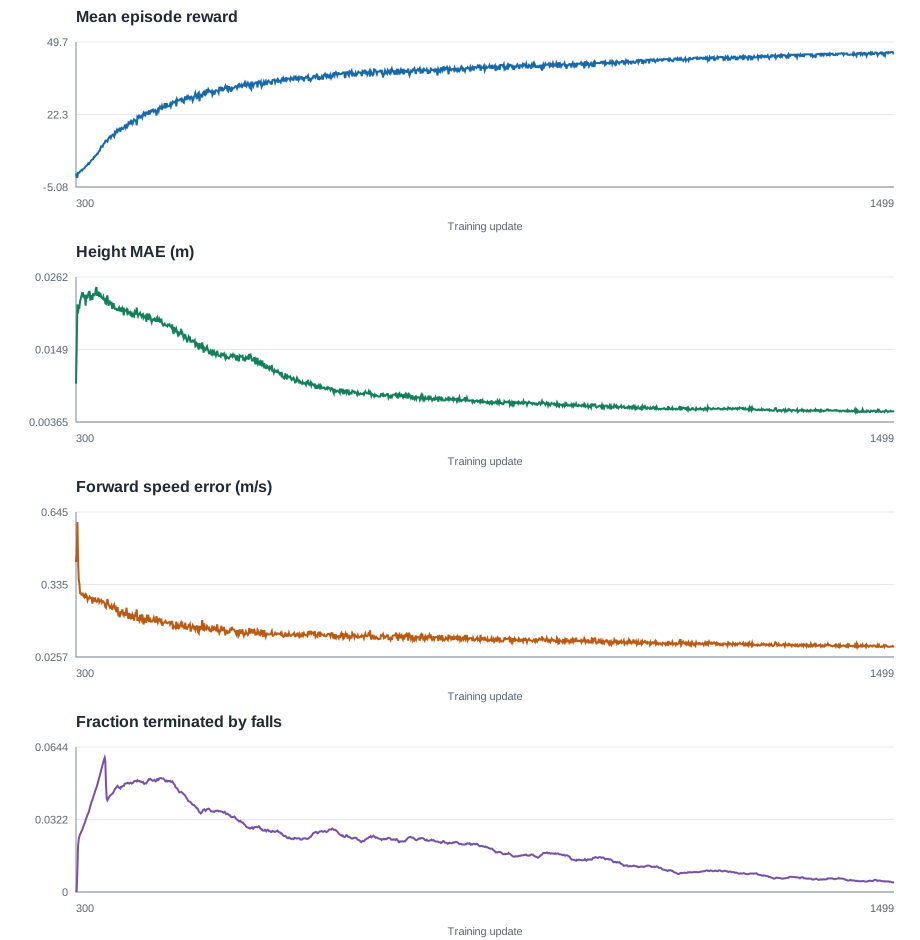
The stock flat-ground G1 velocity task did not represent the requested height behavior. I added an absolute root-height command in meters, observations for actual and commanded height, a height-tracking reward alongside the velocity objective, and a slew limit for smooth target changes. PPO resumed from checkpoint 300 and trained for 1,200 additional updates at the full approved height range. During training, height targets changed every eight seconds. The training curves show reward, height error, speed error, and fall fraction over the updates.
Evaluation evidence
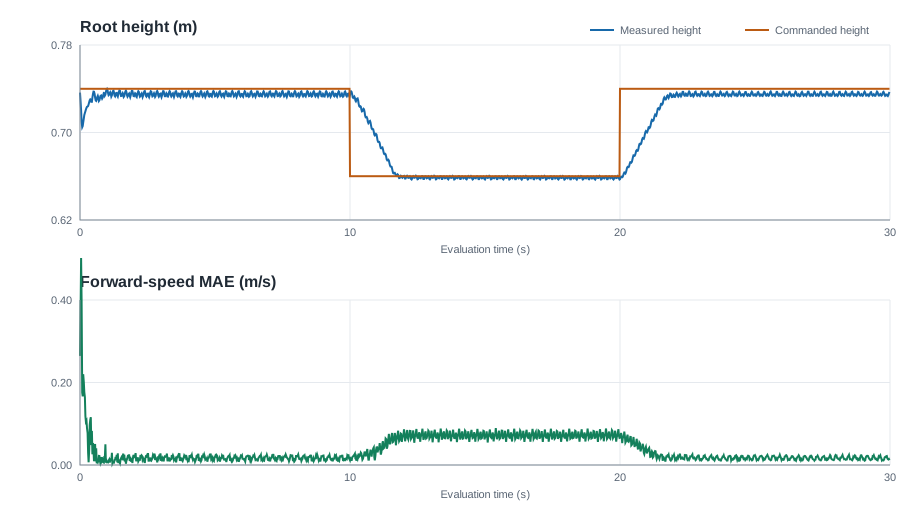
The final checkpoint was evaluated with 32 environments. Each target was held for 10 seconds at 0.5 m/s, giving a 30-second sequence on a flat plane. Domain randomization was disabled for this evaluation.
At 0.74 m, mean absolute height error was 0.00575 m and mean absolute forward-speed error was 0.0231 m/s. At 0.66 m, the errors were 0.00831 m and 0.0655 m/s. On return to 0.74 m, they were 0.01215 m and 0.0212 m/s. No falls occurred, and all 32 environments survived every segment. The lower-height segment produced the largest speed error. The plot shows mean height against the commanded target and forward-speed error through the evaluation sequence.
Limit
The measurements establish only limited command tracking in this flat-ground simulation. The video shows foot scuffing and weak balance, and the evaluation did not score foot clearance, gait quality, or stability margin. There is no evidence yet that this policy will transfer to the physical G1. Before considering hardware tests, improve and measure gait quality, evaluate across randomized dynamics, terrain and disturbances, then validate through a supervised, safety-limited sim-to-real process.
Videos
The final checkpoint video shows the policy lowering the commanded root height from 0.74 m to 0.66 m and returning to 0.74 m while walking.
The earlier checkpoint 500 preview records an intermediate stage of training.